Jigarrang marmarsimon qandala (Halyomorpha halys Stal)
In cooperation with scientists from the Scientific Research Institute of Plant Quarantine and Protection and the Institute of Zoology, an external quarantine pest, the Brown Marbled Beetle (Halyomorpha halys Stal), has b...
In cooperation with scientists from the Scientific Research Institute of Plant Quarantine and Protection and the Institute of Zoology, an external quarantine pest, the Brown Marbled Beetle (Halyomorpha halys Stal), has been identified in agricultural areas of our Republic. This pest is considered very dangerous and damages about 300 agricultural crops.
Currently, research is being conducted on the identified external quarantine pest in cooperation with scientists from the Scientific Research Institute of Plant Quarantine and Protection and the Institute of Zoology.
Brown Marbled Beetle (Halyomorpha halys Stal). The Pentatomomorpha infraorder of semi-rigid insects belongs to the Pentatomidae family (Aukema et al., 2006). The Pentatomidae family currently has about 5,000 species belonging to 900 genera worldwide (Schuh, Slater. 1995; Rider. 2006), 139 species in Kazakhstan (Esenbekova, 2015), about 130 in Tajikistan (Kirichenko, 1966), and about 100 in Uzbekistan (Popov, 1976; Aukema et al., 2006).
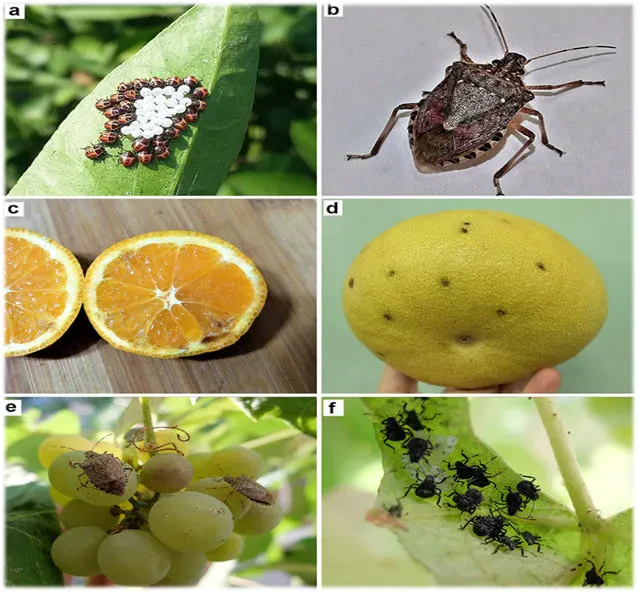
a. larvae hatched from the egg of the fruit fly
b. adult fruit fly
c. damaged orange
d. damaged orange
e. damaged orange
f. fruit fly larva
Pest: The brown marbled fruit fly (Halyomorpha halys Stal) is a nearly omnivorous pest that causes significant damage to more than 300 agricultural crops belonging to 49 botanical families. Young larvae and adult beetles always feed on the same plant species, most of which cause significant damage to young fruit trees, cucurbits, berries, legumes, corn, ornamental and decorative plants.
External structure: The beetle is mainly brown-brown in color. The males are on average 12-14 mm long, and the females are relatively larger, 14-17 mm long. The diameter of their eggs is around 1.2-1.3 mm. The larvae develop in 5 stages (instars). The length of one-year-old larvae is 1.2-1.5 mm, at two years old 2.6-3.0 mm, at three years old 4.2-4.4 mm, at four years old 8.8-10.2 mm, at five years old 11.0-11.5 mm. The antennae consist of 5 segments, with the 4th and 5th segments being 2 mm longer than the other segments. The first segment is so small that it is barely visible, averaging 0.7 mm in length. Only the 4th and 5th segments of the antennae have black rings. The main characteristic of this species is the presence of small, inconspicuous white bumps behind the compound eyes. The outer wings have 5 black spots arranged in a double row on the last membranous membrane. There are 5 pairs of clearly visible black spots below the tergite (connexivum). Males and females are distinguished by their genitalia.
1.adult
2.cuckoo egg
3. 1st instar cuckoo larva
4. 2nd instar cuckoo larva
5. 3rd instar cuckoo larva
6. 4th instar cuckoo larva
Life cycle: Adult cuckoos hibernate in various buildings in people's homes. This pest enters homes through cracks in walls and their joints, hibernates in more comfortable and warmer places. Thus, several thousand insects can gather in one house. In early spring, when heat sources are turned off, cuckoos gather on the ceilings of houses or around light bulbs, causing a number of inconveniences. In spring, the female cuckoo begins to lay white eggs measuring 1.3 mm to 1.6 mm long. Usually, the female cuckoo lays 20-30 eggs in groups on the back of leaves. The nymphs that hatch from the eggs remain in the places where the eggs were laid for several days. The larvae of this species consist of five instars, each instar larva is similar to the other, differing in one aspect.
The first-instar nymphs are orange or red. In the second-instar larval stage, the color of the larvae becomes dark, almost black. The last-instar larvae have a whitish-brown color. The full development period lasts 35-45 days. In humid subtropical Russia and Abkhazia, it develops three generations per year. The first generation lasts from the first decade of May (from egg laying) to the second and third decades of June to the first decade of August. The third generation lasts from the first decade of August to the first decade of October. After that, the imago, that is, the adult, goes into winter diapause.
Use of pheromone traps:
Pheromone traps for the external quarantine pest marbled beetle are installed around airports, railway stations, border posts, and areas bordering foreign countries to monitor the presence of the pest.
After the pheromone is installed, the traps are left in place until the first mature male hatches.